At a glance
AI-SANA infographic
Tap to open the full-size version.
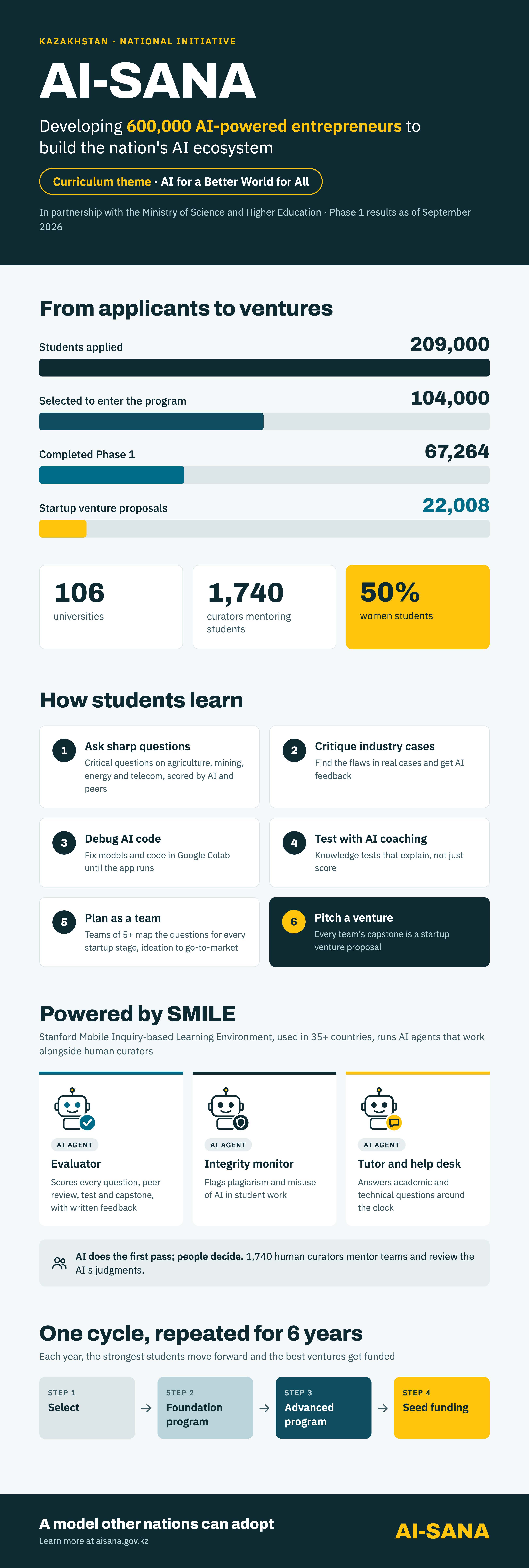
Developing 600,000 AI-powered entrepreneurs
to build the nation's AI ecosystem
A free national program for university students across Kazakhstan, run in partnership with the Ministry of Science and Higher Education and powered by Stanford's SMILE learning platform. No technical background required.
AI-SANA is Kazakhstan's national effort to turn university students into builders of the country's AI economy. Rather than teaching AI as theory, students learn to ask sharp questions about real industries, work hands-on with AI code, and design startup ventures that apply AI to problems in Kazakhstan.
The program runs as a yearly cycle. A broad first stage gives students basic AI skills. Students who go further join a selective, team-based program that ends with a startup venture proposal. Each year the strongest students move forward and the best ventures get funded.
A large-scale introduction to artificial intelligence for students across the country's universities.
A selective program where teams combine AI skills with entrepreneurship and design thinking, ending in a startup capstone. It runs as a Foundation program followed by an Advanced program.
Phase 1 results as of September 2026.
Lectures alternate with hands-on experiments, and every claim gets tested. Students work in teams from day one.
Critical questions on agriculture, mining, energy and telecom, scored by AI and peers.
Find the flaws in real cases and get AI feedback.
Fix models and code in Google Colab until the app runs.
Knowledge tests that explain, not just score.
Teams map the questions for every startup stage, from ideation to go-to-market.
Every team's capstone is a startup venture proposal.
About 15 hours a week, free of charge. Students work in Python on Google Colab and with real AI models and APIs.
Case studies and capstones focus on Kazakhstan's priority industries:
The Stanford Mobile Inquiry-based Learning Environment, used in 35+ countries, runs AI agents that work alongside human curators.
Scores every question, peer review, test and capstone, with written feedback.
Flags plagiarism and misuse of AI in student work.
Answers academic and technical questions around the clock.
AI does the first pass; people decide. 1,740 human curators mentor teams and review the AI's judgments. Learn more about SMILE →
Each year, the strongest students move forward and the best ventures get funded.
A model other nations can adopt.
A 2½-minute overview of Stage I and Stage II, in Kazakh.
Ministry of Science and Higher Education of Kazakhstan.
Tap to open the full-size version.